Get free quotes

Free tool

Make sense of your alignment printout

Alignment specifications come in millimetres, degrees or minutes. Convert between them for your wheel size, and read what toe, camber and caster do.

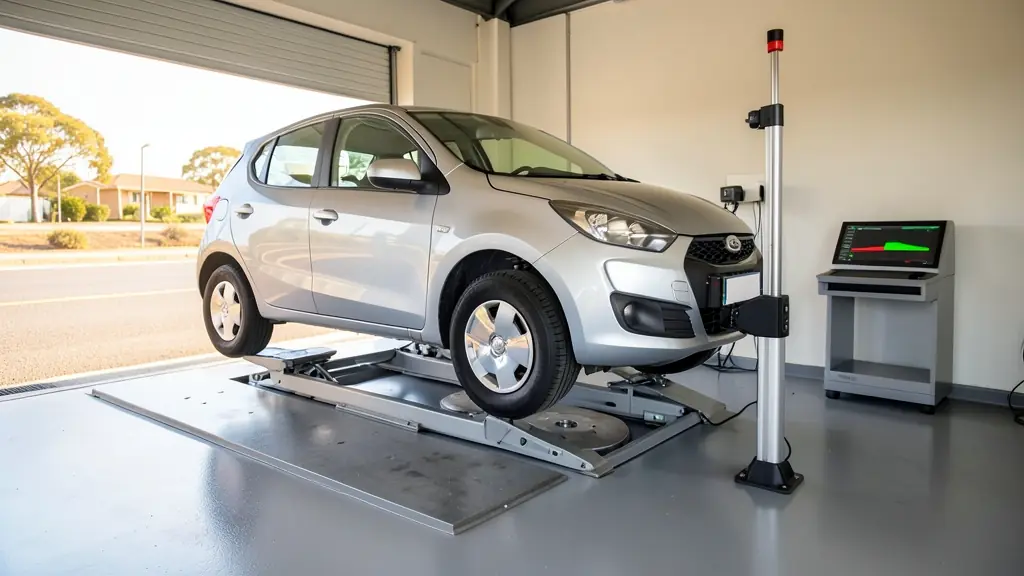
A car on an alignment lift with targets clamped to its wheels

Convert a toe reading

Total toe for the pair of wheels. Toe in is positive, toe out negative.

Toe reading

Total toe
–
In degrees and minutes
–
Per wheel
–
Per wheel, mm
–

Toe is how much the front edges of a pair of wheels point towards each other (toe in) or away from each other (toe out), seen from above. Workshop data and alignment machines show it in degrees, in minutes or in millimetres measured across the rim. Because a millimetre reading depends on the diameter it is measured at, converting needs the wheel size.

Toe, camber and caster in plain words

  • Toe: the wheels pointing in or out, seen from above. Too much wears the tyre edges in a feathered pattern quickly, often in a few thousand kilometres.
  • Camber: the wheel leaning in at the top (negative) or out (positive), seen from the front. Too much wears one shoulder of the tyre.
  • Caster: the tilt of the steering axis, seen from the side. It makes the steering return to centre and keeps the car straight at speed.

On most cars toe is adjustable at the track rod ends. Camber and caster are often fixed and only change when something is bent or worn, which is why a hard pothole hit can need more than a standard alignment.

How the conversion works

The calculator treats the toe reading as the difference between the front and rear of the wheel, measured across the diameter you choose. One degree is 60 minutes. Total toe is for the pair of wheels on an axle; individual toe is for one wheel and is half the total. Specifications in workshop data are usually given as a total with a tolerance, for example 0°10' ± 0°10'.

For a quick feel: on a 16 inch rim, 1 mm of total toe is close to 0.14°, or about 8.5 minutes.

Signs your alignment is out

The car pulls to one side on a straight, level road, the steering wheel sits off centre when you drive straight, or the inner or outer edge of the front tyres wears faster than the middle. Have it checked after new tyres, after replacing steering or suspension parts, and after any hard hit on a kerb or pothole. Compare the before and after printout the workshop gives you.

Frequently asked questions

Which diameter should I use?
Use the one your specification is based on. Many alignment machines and data sheets use the rim diameter; some older methods measure across the tyre. If the spec does not say, use the rim diameter. The difference is small for small toe values.
What is a normal toe setting?
It depends on the vehicle. Many front wheel drive cars run close to zero or slight toe out at the front, and many rear wheel drive vehicles run slight toe in. Use the figure in the workshop data for your vehicle; the alignment centre has it.
Is toe in or toe out positive?
By convention toe in is positive and toe out is negative. Enter a negative number in the calculator for toe out.

Related services

Free quote request, no obligation

Request wheel alignment quotes

Fill in the job card the way a wheel shop would: what is wrong, the wheel size and finish or the vehicle, where you are and how soon. Repairers, tyre shops and suppliers in your area quote you directly.

Job card No. 51611Wheel Alignment

1The job

2The vehicle (optional, it helps the quote)

Your vehicle, from above

-
-
-
-
-
-
Estimate
-

A rule of thumb, not a quote.

3Stage, condition and timing

4Your list (optional)

  1. 01
  2. 02
Up to 12 lines: wheels, tyres, vehicles, machines or supplies.
Needs and options

5Your details

Free and no obligation. By sending you agree that we may share your request with suitable repairers, tyre shops and suppliers. See our privacy policy.

Get free wheel repair quotes