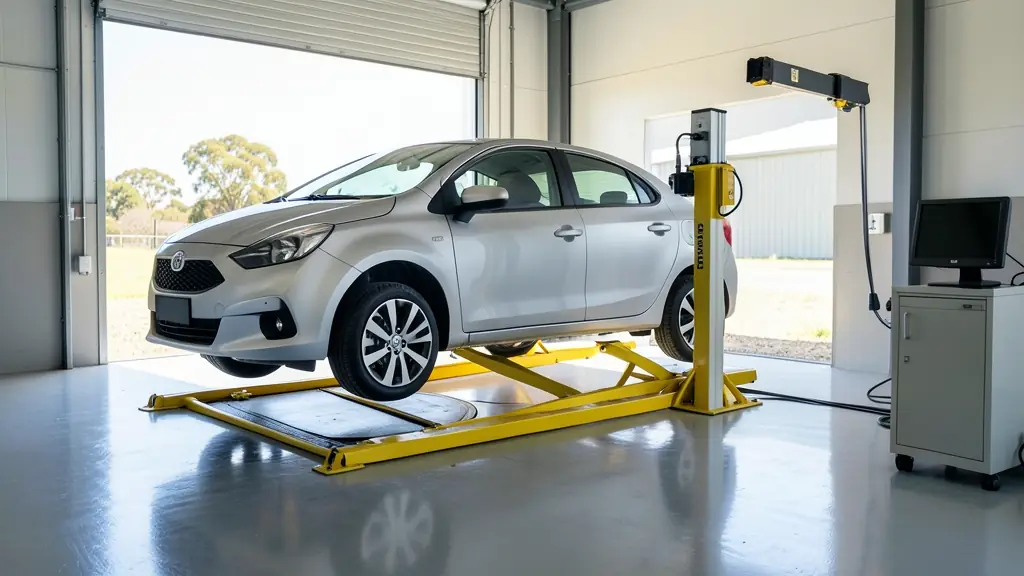
A wheel alignment machine earns its place in a tyre shop when every set of new tyres leaves with a printout, and most customers will pay for a check after a pothole. Choosing one is less about the brochure and more about your bay: the lift or pit you have, the floor, the cars you see most, and whether a supplier near you will calibrate it and keep the vehicle database current. Tell us what you need and we pass the request to independent equipment suppliers, who quote you directly.
CCD sensor heads or a 3D camera aligner
A CCD aligner uses four sensor heads clamped to the wheels that see each other with cameras or infrared beams. They are usually cheaper, work on a pit or a basic lift, and suit a shop doing a handful of alignments a day, but the heads need charging, careful handling and a compensation run. A 3D camera aligner uses lightweight targets on the wheels and fixed cameras on a beam. Set-up is quicker, there is less to drop, and a busy bay can turn cars faster. It needs more space in front of the lift and a beam that stays rigid, and the cameras must be recalibrated if the beam is knocked.
The lift, pit and floor matter as much
Alignment readings assume the car sits on a level surface. A four-post lift with turntables and slip plates is the common choice; a scissor lift saves floor space; some older workshops use a pit. Whatever you have, the runways must be level to each other, and the floor must carry the bolts. Ask the supplier to check this before they quote, because a cheap aligner on an uneven lift gives readings nobody trusts. A shop doing wheel alignment for bakkies and double cabs needs a lift rated for the weight and long enough for the wheelbase.
Database, software and load-shedding
The vehicle database holds the maker's toe, camber and caster figures. New models arrive every year, so ask how updates are delivered, how long they are included and what a renewal costs. Ask whether the console runs on a standard PC that can be replaced locally. Plan for load-shedding: a UPS keeps the console from shutting down mid-job, and an inverter or generator keeps the lift running.
- Single phase or three phase supply for the lift
- Training for your staff, on site or at the supplier
- Calibration on installation and how often after
New, refurbished or second hand
Second-hand aligners come up when shops upgrade or close. They can be good value, but check the age of the software, whether the database can still be updated, and that the heads or cameras are complete and calibrate. A refurbished machine from a supplier usually comes with some warranty. Many shops pair an aligner with wheel balancing machines and a tyre changer machine on one quote.
What to put in your request
- CCD or 3D camera aligner, or ask for both
- Your lift or pit, and the bay size
- Vehicles you align most: cars, bakkies, trucks
- Single phase or three phase power
- New, refurbished or second hand
Wheel Alignment Machines for drivers, fleets and workshops
- Private car owners: not usually a buyer, but the reason a tyre shop can print before and after readings
- Enthusiasts, 4x4 and performance drivers: a home garage or club workshop aligning lowered and modified cars for track days
- Company and rental fleets: an in-house workshop aligning delivery vans and bakkies on a schedule instead of outsourcing
- Dealers, panel shops and insurers: a dealer workshop checking alignment on used cars before they go on the floor
- Tyre shops and wheel workshops: a tyre shop or fitment centre adding alignment to every new set of tyres
- Truck, bus and taxi operators: a truck workshop aligning steer and drive axles to save tyres on long hauls
- Farms: a rural tyre shop on the platteland aligning bakkies that live on gravel roads
- Mines and construction sites: a mine workshop keeping LDVs aligned after rough haul roads chew the tyres
Frequently asked questions
Do you sell alignment machines yourselves?
How much space does a wheel alignment machine need?
Can I use my existing lift?
What should be in an aligner quote?
Wheel Alignment Machines by province and city
- Johannesburg
- Pretoria
- Centurion
- Midrand
- Sandton
- Randburg
- Roodepoort
- Krugersdorp
- Randfontein
- Germiston
- Boksburg
- Benoni
- Kempton Park
- Alberton
- Vanderbijlpark
- Vereeniging
- Durban
- Pinetown
- Pietermaritzburg
- Richards Bay
- Newcastle
- Ladysmith
- Gqeberha (Port Elizabeth)
- East London
- Kariega (Uitenhage)
- Mthatha
- Cape Town
- Bellville
- Paarl
- Stellenbosch
- George
- Worcester
- eMalahleni (Witbank)
- Middelburg
- Secunda
- Mbombela (Nelspruit)
- Rustenburg
- Brits
- Klerksdorp
- Potchefstroom
- Mahikeng
- Polokwane
- Tzaneen
- Kimberley
- Upington
- Bloemfontein
- Welkom
- Sasolburg