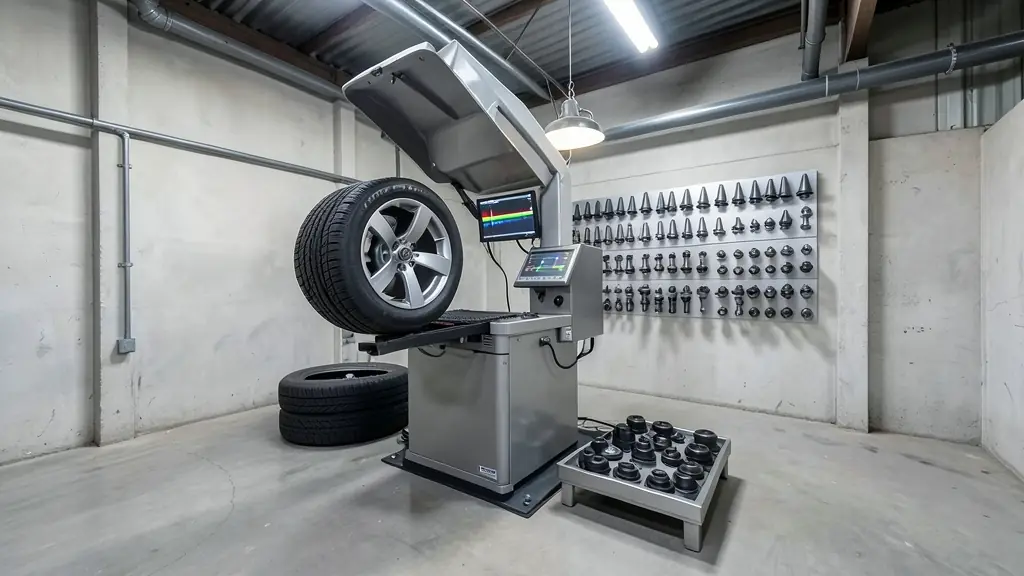
A wheel balancing machine is used on almost every job in a tyre shop: new tyres, puncture repairs, repaired mags and customers who feel a shake at 120 km/h. Most modern balancers are computerised and fast, but they differ in how they measure the wheel, how they mark where weights go and how well they hold calibration. Tell us what you balance and how many a day, and we pass the request to independent equipment suppliers, who quote you directly.
Dynamic balancing and what the machine measures
A computerised balancer spins the wheel and measures the imbalance in two planes, inner and outer, which is dynamic balancing. It then shows where to fit weight and how much. To do that it needs the rim width, diameter and the distance from the machine. Basic balancers have you enter these by hand with a calliper and a pull-out arm. Auto data entry arms measure distance and diameter when you touch the rim, and some machines use a laser or sonar for the width, which cuts mistakes when fitters are rushed.
Laser spot, weight modes and split weights
On alloys, stick-on weights go inside the barrel, and placing them in the right spot matters. A laser spot or pointer shows exactly where the weight goes, so it is not stuck a few centimetres off. Look for modes for clip-on weights on steel rims, hidden weights behind the spokes and a split weight option that hides weights behind two spokes. A function that matches the tyre to the rim can reduce the weight needed. These features matter more if you balance repaired wheels from rim repair machines.
Cones, adapters, calibration and the floor
A balancer is only accurate if the wheel is centred. Cones suit most centre bores, but wheels that centre on the studs, or premium wheels with tight bores, need flange plates or pin adapters. Ask which come with the machine. Most balancers must be bolted to a solid concrete floor or they shake and give drifting readings. Calibration is usually done with a weight supplied with the machine; ask how often the supplier recommends it.
- Single phase power for most car balancers
- Safety hood that starts the spin
- Brake that stops the wheel at the weight position
Truck balancers and second hand
A truck wheel balancer takes 22.5 inch wheels and heavy tyres, usually with a lift to raise the wheel onto the shaft. Some are mobile, for fleets. Second-hand balancers can be good buys: spin a known balanced wheel twice and check the readings repeat, listen for bearing noise in the shaft, and make sure the cones and quick nut come with it, because replacements for an old model can be hard to find. Many shops buy one alongside a tyre changer machine and weights by the box.
What to put in your request
- Car, truck or both
- Manual, auto data entry or laser measuring
- Adapters needed: cones, flange plate, pins
- Floor type and power supply in the bay
- New, refurbished or second hand
Wheel Balancing Machines for drivers, fleets and workshops
- Private car owners: the machine that stops a new set of tyres shaking the steering wheel
- Enthusiasts, 4x4 and performance drivers: a performance shop balancing large, light wheels with hidden weights
- Company and rental fleets: a fleet workshop balancing van and bakkie wheels after every tyre change
- Dealers, panel shops and insurers: a dealer workshop balancing refurbished wheels before a car is sold
- Tyre shops and wheel workshops: a tyre shop or mag repairer balancing every wheel that leaves the bay
- Truck, bus and taxi operators: a truck depot balancing steer tyres to cut vibration and uneven wear
- Farms: a country tyre shop balancing bakkie and 4x4 wheels that run on gravel
- Mines and construction sites: a mine workshop balancing LDV wheels after tyre and rim repairs
Frequently asked questions
Do you sell the balancing machines?
How do I know a balancer is accurate?
Do I need a laser balancer?
Can one machine balance car and truck wheels?
Wheel Balancing Machines by province and city
- Johannesburg
- Pretoria
- Centurion
- Midrand
- Sandton
- Randburg
- Roodepoort
- Krugersdorp
- Randfontein
- Germiston
- Boksburg
- Benoni
- Kempton Park
- Alberton
- Vanderbijlpark
- Vereeniging
- Durban
- Pinetown
- Pietermaritzburg
- Richards Bay
- Newcastle
- Ladysmith
- Gqeberha (Port Elizabeth)
- East London
- Kariega (Uitenhage)
- Mthatha
- Cape Town
- Bellville
- Paarl
- Stellenbosch
- George
- Worcester
- eMalahleni (Witbank)
- Middelburg
- Secunda
- Mbombela (Nelspruit)
- Rustenburg
- Brits
- Klerksdorp
- Potchefstroom
- Mahikeng
- Polokwane
- Tzaneen
- Kimberley
- Upington
- Bloemfontein
- Welkom
- Sasolburg